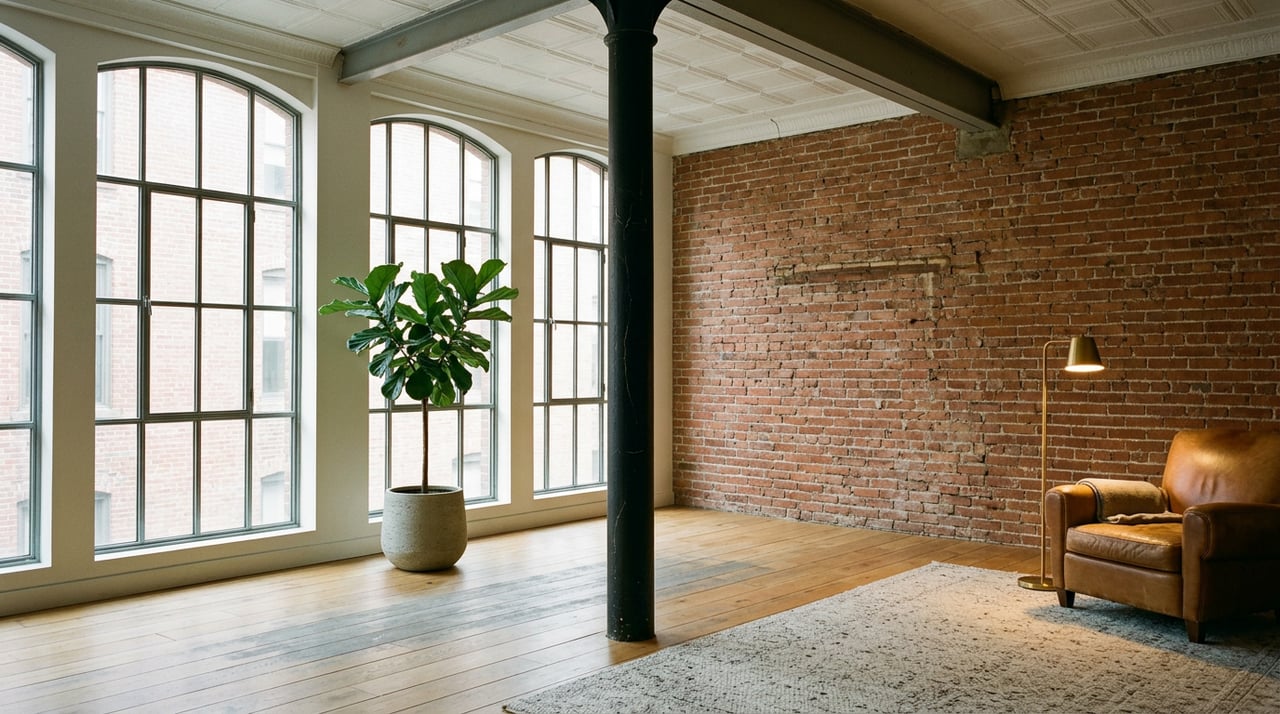
You walk into a loft on Mercer Street. Twelve-foot ceilings, cast-iron columns still wearing their original paint, light pouring through arched windows that have been there since the building moved dry goods instead of dinner parties. Your broker mentions, almost in passing, that the unit's Certificate of Occupancy still lists it as a Joint Living-Work Quarters for Artists. You nod, assume it's a formality from the neighborhood's bohemian past, and keep looking at the light.
It is not a formality. As of this year, it is a number, and the number has a clock attached to it.
On January 13, 2026, New York's Court of Appeals ruled 6-1 that the city can keep charging that number. The ruling settled one legal question. It did not settle the practical one that matters to anyone with a contract, or a listing, on a SoHo loft: whether to pay now, or bet on a wait that gets more expensive every year you take it.
What JLWQA actually restricts
In 1971, the city created a use category called Joint Living-Work Quarters for Artists, JLWQA for short, to legalize what artists had already been doing quietly in SoHo and NoHo's former manufacturing lofts. Under the Multiple Dwelling Law, occupancy in a building carrying that designation was limited to residents certified as professional artists by the city's Department of Cultural Affairs. For decades the rule was barely enforced. By 2022, only 36 of the roughly 1,636 designated JLWQA units in the neighborhood were actually occupied by a certified artist, according to reporting on the case in The Real Deal.
That gap between what the paperwork says and who actually lives there is exactly what a 2021 rezoning tried to close, and exactly what makes the designation worth checking before you write an offer.
The price of making it official
The 2021 rezoning gave JLWQA owners a legal way out. Pay the city a nonrefundable contribution of $100 per square foot of the space being converted into the SoHo-NoHo Arts Fund, and the unit's occupancy restriction lifts for good. On a 2,500-square-foot loft, that fee started at $250,000 the year the rule took effect, and it does not sit still. The zoning resolution that created it built in automatic annual increases, and by one accounting in August 2024 the effective rate had already climbed toward $116 per square foot. Ask your building's managing agent for the current published rate before you do any math on an offer, because it will not match a number you read online today.
That fee is what the artists who sued the city were fighting, and what the Court of Appeals just upheld.
A ruling built on where the money goes, not where it comes from
The case, Matter of the Coalition for Fairness in SoHo and NoHo v. City of New York, worked its way through three courts before landing at New York's highest bench. A trial court sided with the city in 2023. The Appellate Division reversed that in December 2024, finding the fee unconstitutional under the line of Supreme Court cases running from Nollan through the 2024 decision in Sheetz v. County of El Dorado, the same doctrine that limits how much a government can charge a property owner for permit approval. The Court of Appeals then reversed the Appellate Division in January 2026, reasoning that a standalone monetary fee, one not offered as an alternative to handing over an actual property interest, does not trigger the same constitutional scrutiny as a land dedication would.
One resident living through it put it plainly to amNewYork after the ruling came down.
"I have no idea how we'll deal with this."
That resident is not alone in wondering. Attorney Christopher Kieser, who argued the case for the coalition, has filed a petition asking the United States Supreme Court to take it up. The petition is backed by an amicus brief joining the Manhattan Institute with the National Association of Realtors, the New York State Association of Realtors, the National Association of Home Builders, and the National Apartment Association, all arguing the state court read the underlying doctrine too narrowly. Kieser has said publicly that even a favorable outcome at the Supreme Court would put a new decision more than a year out. Petitions for certiorari are rarely granted at all.
Why banks started caring about a 1971 zoning quirk
None of this would matter much to a buyer if lenders treated a JLWQA designation as background noise. They stopped doing that after the 2008 financial crisis, when stricter underwriting made banks wary of financing units where a foreclosure could leave them holding an apartment nobody without an artist certification is legally allowed to occupy. That caution is one reason the designation resurfaced as a real transaction issue rather than a historical footnote, and it is why a lender today may ask more questions about a unit's Certificate of Occupancy than a buyer expects.
Three categories, not one problem
Before you get attached to a specific address, find out which of three buckets it actually falls into.
| Category | What governs it | Arts Fund exposure |
|---|---|---|
| JLWQA, not yet converted | City zoning resolution, artist-occupancy rule | Fee applies if you convert to unrestricted residential use |
| JLWQA, already converted | Recorded instruments with the City Register, certified by City Planning | None, the fee has already been paid |
| State Loft Law building (IMD) | NYC Loft Board, not city zoning | Exempt from the SoHo-NoHo Arts Fund process entirely |
The building's Certificate of Occupancy, available through the Department of Buildings' Buildings Information System, is where this gets resolved. Same cast-iron blocks, same twelve-foot ceilings, three entirely different legal positions and three different price tags attached to certainty.
The actual decision is about timing, not law
Here is the thesis worth sitting with if you are on either side of a SoHo loft deal this year: the Court of Appeals ruling didn't close the question, it just changed who is placing the bet. City Council Member Christopher Marte, whose district covers SoHo and NoHo, has told reporters he is pursuing legislation to cut the fee closer to negligible, while acknowledging nobody knows whether that bill moves before the Supreme Court decides whether to even hear Kieser's petition.
That leaves a buyer or a seller weighing a JLWQA unit with three real options, and all three cost something. Pay the fee now and lock in this year's rate. Wait for Marte's legislative fix, which may never pass. Or wait for the Supreme Court, knowing a favorable ruling is a year or more away and every year of waiting adds another 3% to the number you would eventually owe if the city ultimately prevails or the court declines to hear the case. There is no version of waiting that is free. There is only a version where you know the odds you are taking and a version where you find out at closing.
What to ask before you sign
- Pull the Certificate of Occupancy from the Department of Buildings and look for a JLWQA designation before you fall in love with the light.
- If the unit already converted, ask for the recorded certification from City Planning confirming the Arts Fund contribution was made.
- If it is a State Loft Law building registered as an Interim Multiple Dwelling, confirm that status directly with the NYC Loft Board rather than taking a listing sheet's word for it.
- Ask your lender whether they will underwrite a unit without a standard residential Certificate of Occupancy, or whether you will need a workaround that could slow your closing.
- If you are the seller, get this year's published Arts Fund rate from your managing agent rather than quoting a number from an old article, including this one.
FAQ
Do I have to be a certified artist to buy a SoHo loft today? Only if the specific unit still carries an unconverted JLWQA designation and you intend to occupy it without paying the conversion fee. Units that already converted, or that were never JLWQA, carry no such requirement.
Does the fee work the same way for co-ops and condos? The fee itself is calculated per square foot of the unit converting, regardless of ownership structure. What differs is the approval path. A co-op board can layer its own requirements on top of the city's process, so budget time for board review either way.
If the Supreme Court takes the case, does that freeze the fee in the meantime? Nothing in current reporting suggests an automatic freeze. The fee schedule, including the annual increase, stays in effect unless a court order or new legislation says otherwise.
A SoHo loft is one of the few property types in Manhattan where the zoning history matters as much as the layout. If you are weighing a purchase or a sale in a JLWQA building this year, the right first call is to someone who reads a Certificate of Occupancy the way a lawyer reads a contract, because that is what it is.
CB Lux Real Estate works across SoHo's landmarked blocks with the legal background to price a designation like this into your offer, not discover it after signing. Request a Private Consultation to walk through what a specific address actually carries before you write the check.